Zero Trust Architecture, Explained Without the Marketing Buzzwords
"Zero Trust" has been on every security vendor's homepage for a decade, attached to products that range from genuinely relevant to completely unrelated. That marketing noise has made the actual concept harder to understand than it needs to be. Stripped of the buzzwords, it's a single architectural principle with concrete implications.
The old model it's replacing
Traditional network security worked like a castle: a strong perimeter (firewall, VPN) and an assumption that anything inside that perimeter was trusted. Once you were on the corporate network, you generally had broad access — the network location itself was the credential.
The problem is obvious in hindsight: perimeters leak. A phished VPN credential, a misconfigured firewall rule, a compromised laptop that's technically "inside" — any of these gives an attacker the same broad trust a legitimate employee has, because trust was based on where the request came from, not what the request actually is.
The Zero Trust principle, stated plainly
Never trust based on network location. Verify every request, every time, based on identity and context — regardless of whether it originates inside or outside the network perimeter.
That's the whole idea. Everything else is implementation detail.
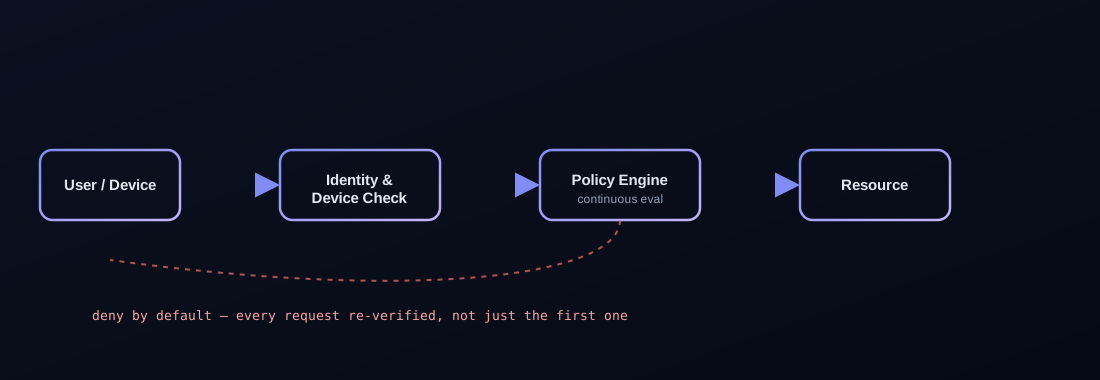
What "verify every request" actually requires
This is where it gets concrete, and where most of the real engineering work lives:
- Strong identity for everything — not just users, but services, devices, and workloads each need a verifiable identity, not an implicit one based on IP address or network segment.
- Least-privilege access by default — access is granted per-resource, per-action, not "you're on the network, so you can reach everything on it." In Kubernetes, this is what network policies enforce at the pod level.
- Continuous evaluation, not one-time login — a session being valid five minutes ago doesn't mean the same request should be trusted now. Device posture, location, and behavior get re-evaluated, not just checked at login.
- Micro-segmentation — instead of one flat trusted network, resources are isolated so that compromising one doesn't grant access to everything else. A pod compromise shouldn't mean lateral movement to every other pod in the cluster — which, without network policy enforcement, is exactly the default state.
What it looks like in a cloud-native stack
In practice, on a Kubernetes platform, "Zero Trust" isn't a product you install — it's the sum of several concrete controls working together: mTLS between services (so identity is cryptographic, not network-based), default-deny network policies, RBAC scoped to what each service account actually needs, and a policy engine (OPA/Gatekeeper, Kyverno) that evaluates every request against explicit rules rather than implicit trust.
Why this matters more in cloud-native environments specifically
Zero Trust existed before Kubernetes, but cloud-native architectures make the old perimeter model fail faster. Services talk to dozens of other services, scale up and down constantly, and often span multiple clusters or clouds — there's no stable "inside the firewall" to define a perimeter around in the first place. Zero Trust isn't an optional upgrade for this environment; it's closer to the only model that actually fits it.
Going deeper
If you want the hands-on version — writing real default-deny network policies, wiring up mTLS, and seeing what breaks (and why that's the point) — that's core to our DevSecOps Masterclass. And if you want the audit-grade research behind why "compliant on paper" often isn't "enforced in practice," see our paper on measuring security control effectiveness.
Discussion
More from the blog

Top DevSecOps Interview Questions (and How to Actually Answer Them)
Real DevSecOps interview questions, and what separates a memorized textbook answer from the answer that actually gets you hired.

Kubernetes Roadmap for Security Professionals
A practical guide to planning skills, projects, and next steps for security professionals moving into Kubernetes and cloud-native roles.